
Ecological consumption
Is there really so much difference between a food that is organic and another that is not?
Of course, although sometimes it cannot be seen with the naked eye. We can say that there are two clear differences: the way in which it has been produced and the quality of the food itself. Organic food is produced with the minimum of environmental impact. No pesticides, herbicides or synthetic mineral fertilisers are used. The contamination of the environment that occurs systematically in conventional industrialised agriculture does not happen with the practice of organic farming.
Therefore, even though it cannot be seen, behind organic food lies the preservation of the environment. Regarding the quality of the organic product, there is a characteristic that cannot be seen with the naked eye but is very important: the absence of synthetic chemical pesticide residues. This fact alone gives organic food a health guarantee that conventional food does not have. In addition, several studies have shown that the nutritional quality of organic food is higher. This is largely explained by the fact that organic food has been grown without forcing and intensifying its production, allowing the crop to develop more at its own pace on fertile and living soil.
Can any food product be obtained organically?
Most foods have regulations that specify the conditions under which organic food must be produced and processed. Thus we can find any fresh and processed fruit and vegetables, meat, eggs, milk and any other animal production, honey, wine, oil, nuts, ready meals, frozen dishes, etc., all organically produced.
It is true that there may be certain types of food that are more difficult to obtain and are therefore less present in the market. We hope that the already extensive range of organic food will become ever broader and more accessible.
Can organic food only be sold in certain shops?
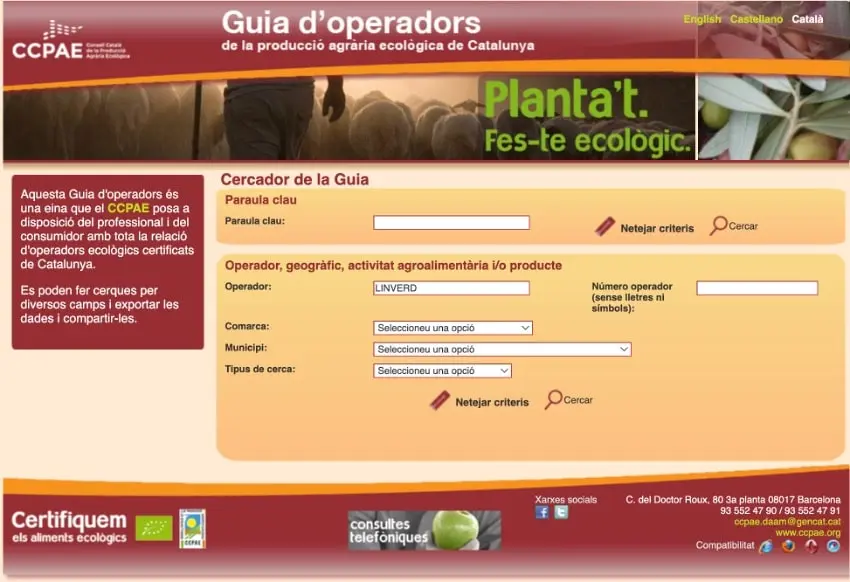
There is no restriction on the types of businesses that can sell organic products. The CCPAE does give businesses that want to stand out the option of joining a register of Recommended Retail Establishments. The CCPAE carries out checks on these establishments and publishes a Directory Guide in which they are listed. On the CCPAE website (ccpae.org) you will find information on how to become a Recommended Shop.
Do all organic foods have a mark that identifies them as such?
The seal of the body that certifies it as organic must appear on the label of organic food packaging. It must be very clear that no food can be called or advertised as organic if it is not certified and does not carry the corresponding seal. Some product labels, for market reasons, carry seals from several certifiers.
It should be clear that having more seals does not mean that it is more organic. That said, it must have at least one valid seal. On the CCPAE website (ccpae.org) you can see the different types of seals that can be found on organic products and the certifying body that corresponds to each one.